
Milwaukee Previous Resident Sources
No single Milwaukee record proves every person who occupied a house. The strongest search combines ownership, occupancy, and building evidence. The county deed archive identifies transfers of title. Reverse directories name an occupant or business at an address. Tax rolls and permits connect a legal parcel to an owner or construction event, while census schedules can reveal a whole household. The ranges below show why the starting source should match the period being studied.
| Source | Years It Covers | Where Held | What It Shows |
|---|---|---|---|
| Recorded deeds | 1835-present | Milwaukee County Register of Deeds | Owners, transfer dates, legal descriptions, document references |
| Reverse directories | 1921-present runs | MPL and MCHS | Occupants or businesses indexed by street address |
| City directories | 1847-present runs | MPL, MCHS, UWM | Names, addresses, occupations, and household clues |
| Tax rolls | 1837; 1846-1984; 1959-present | MPL, MCHS, City Records Center | Historical owner, ward, value, and legal description |
| Building permits | 1888-present for city-limit structures | DNS and permit microfilm | Owner, architect, builder, cost, and work description |
| Federal census | Public releases through 1950 | MPL, MCHS, federal sources | Household members and relationships |
| Fire-insurance atlases | 1876, 1888, 1894, 1910; partial later sets | MPL, MCHS, UWM, Library of Congress | Building footprint, materials, additions, and use |
For a recent Milwaukee address, start with the Assessor and its tax key, then check the newest deed and reverse directory. For a nineteenth-century home, legal descriptions, ward-based tax rolls, deeds, and fire maps matter more than a modern street number. A deed documents ownership, not residence. A directory entry is stronger evidence of occupancy, but it can omit family members and may reflect information gathered months before publication.
Convert Old Milwaukee Addresses
Almost all Milwaukee street numbers changed in 1930, and many south-side street names changed too. That event can make previous residents seem to vanish between one directory and the next. Before searching an address from before 1930, use the Historic Preservation Commission property research guide and its Milwaukee Address Change Directory. Numbered streets are filed by their spelled-out names in the converter, and Cambridge Avenue was renumbered more than once.
Record both the old and new number, the street-name variant, and the directory page that supplied each form. Then check a fire-insurance sheet or tax roll to confirm that the building footprint and legal parcel agree. The city PDF also includes Wauwatosa street-name changes from 1931. Properties once in Town of Lake, Town of Wauwatosa, North Milwaukee, Granville, or Bay View may require records filed under the former municipality.
Use the successful Milwaukee house-history research capture to see the city's own route through address conversion, permits, rolls, and deeds.
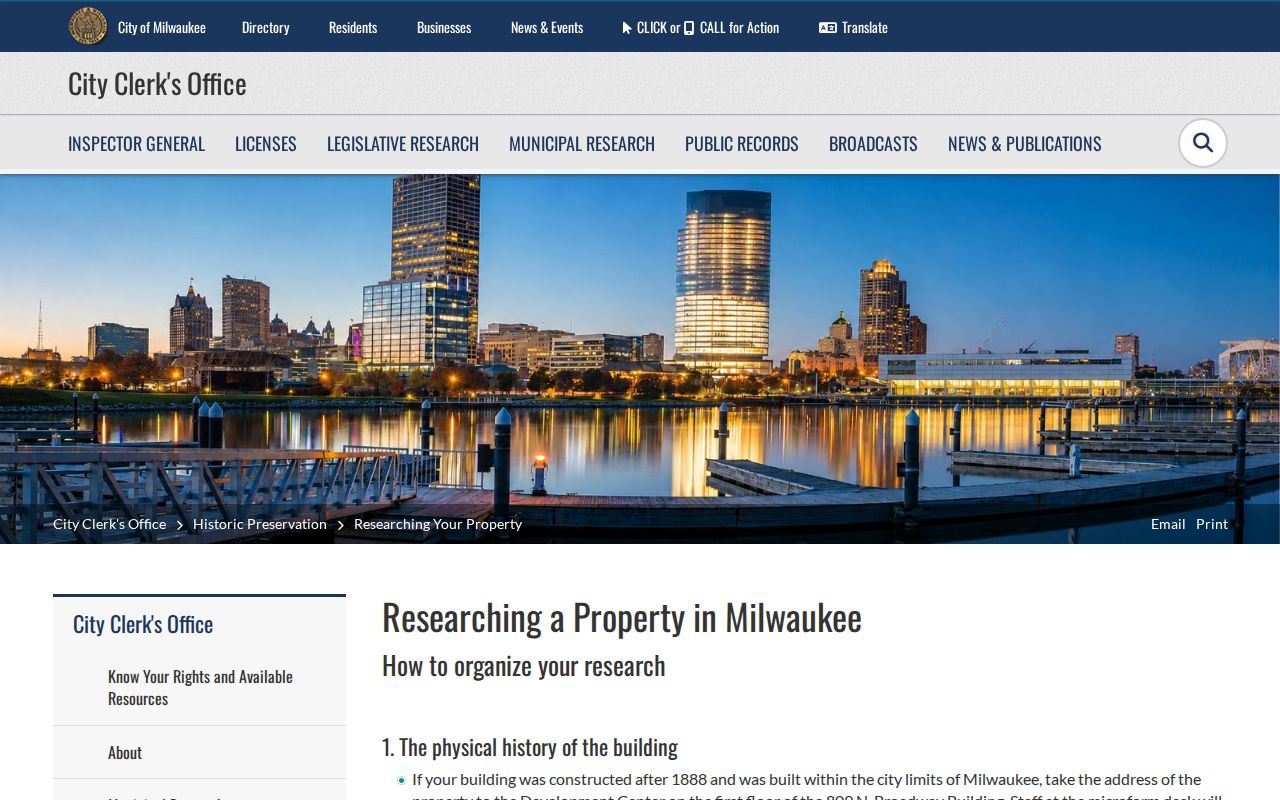
The captured page is a practical checkpoint before an old number is entered in any Milwaukee directory or land index.
Trace Milwaukee's Deed Chain
The City of Milwaukee Assessor Real Property Search supplies the current owner, situs address, tax key, classification, assessed values, exemptions, and sale fields. The situs is the parcel location. An owner mailing address is only where tax correspondence goes, and may differ from the property. Carry the tax key and legal description into the Milwaukee County Register of Deeds real-estate records so spelling changes do not break the chain.
- Find the current parcel and copy its owner name, tax key, and legal description.
- Locate that owner's purchase deed as the grantee, meaning the buyer who received title.
- Read the grantor, or seller, plus the recording date and document or book/page reference.
- Search that seller as an earlier grantee. Repeat while the names and land description remain consistent.
- Before April 1, 1948, switch to document number or book/page and seek staff guidance when the succession becomes complex.
- Grantor and grantee
- The grantor gives or sells title; the grantee receives it.
- Chain of title
- The linked sequence of transfers for the same land.
- Legal description
- The lot, block, subdivision, or other land description that stays useful when an address changes.
Milwaukee's 1948 Index Break
Milwaukee County has digitized real-estate instruments back to 1835, but digitized does not mean searchable the same way. Grantor, grantee, and tract searching applies from April 1, 1948 forward. Records from 1835 through March 31, 1948 require a known document number or book and page. This cutoff is the key insider detail when a name search suddenly stops producing older transfers.
Tapestry is fee-based and is not designed for a complex succession search. Laredo is a professional subscription. A researcher can also use the Register of Deeds counter, mail routes, and certified-copy service. For a complex chain, the county asks for an appointment at least 24 hours ahead. Staff can explain the records, but they do not prepare a finished abstract of title.
Note: Property abstracts can shorten a search, but copies are rare and may survive only with owners, MCHS, or City Records.
Milwaukee Permits and Fire Maps
Permits help date physical change, not every household. Milwaukee permit microfilm begins with structures inside city limits after 1888 and may name an owner, architect, builder, cost, and work description. The DNS Property Information system uses a validated address and tax key to reach complaints, orders, permits, inspections, and attachments. Unregistered ownership may not appear, and a certified record requires a public-records request.
Fire-insurance maps add a second test. Milwaukee collections include 1876, 1888, 1894, and 1910 atlases, plus incomplete sets for 1927, 1929, 1930, 1937, and 1966. A sheet may reveal a footprint, construction material, roof type, garage, addition, or building use. UWM has 1894 and 1910 material online, while MPL and MCHS hold more physical runs. A changed footprint can explain a new unit number or a gap in previous-resident entries.
Tax Keys Bridge Milwaukee Eras
Early Milwaukee tax records may be arranged by ward and legal description rather than today's street address. Ward maps held by MPL bridge that system. The city's Digital Reel, a grantor and grantee index maintained by tax key from the 1920s through 1989, can also connect a parcel when a modern name query is too broad. Tax records reach 1837, with 1846 through 1984 on microfilm and 1959 forward at the City Records Center.
This is where the tax key earns its value. Keep it beside the old and new street numbers, subdivision, lot, block, ward, and municipality. Each item provides a separate way to prove that two records concern the same land. Never force a match based only on a similar surname or nearby house number.
Milwaukee Past Household Trail
Owners are only half the story. Milwaukee city directories can be searched by name from 1847 forward and by address from 1921 forward. Reverse, or criss-cross, directories invert the usual name index and list an occupant or business beneath a street address. Full collection formats and shelf locations belong on the Milwaukee city directory collections page; for previous residents, the task is to sample years around each transfer, permit, and census.
- Search the converted address in the reverse directory for the target year and nearby years.
- Copy the exact name, initials, occupation, spouse notation, and address as printed.
- Check the nearest public federal census, currently through 1950, for household members and relationships.
- Use the next directory to test whether the household stayed, moved, or changed its printed name.
- Confirm endpoints with newspapers, death records, probate, or a later deed instead of relying on one absence.
MPL's newspaper collections include long image runs of the Milwaukee Journal and Sentinel, plus indexes and modern text access. Obituaries may identify relatives and later addresses. Probate may name heirs, an executor, and property involved in an estate. These are endpoints, not substitutes for the address evidence. Search spelling variants because Milwaukee's German, Polish, Jewish, African American, Irish, and other community records may use initials, translated names, or Americanized forms.
Lawful use. Research previous residents for family history, estate work, or the history of a Milwaukee property. Never use an address trail to stalk, harass, or harm a living person.
When Milwaukee Web Searches End
Older Milwaukee records require several access channels. Visit or contact the Frank P. Zeidler Humanities Room for directories, tax rolls, maps, census tools, and reference help. The Milwaukee County Historical Society Research Library holds directories, naturalization papers, probate, court material, family manuscripts, and county archives for reference use. UWM's Golda Meir Library adds directories, Sanborn maps, and archival collections. The Municipal Research Library gives in-person, phone, and email help with city documents, while its E-Vault is restricted to the city network.
A specific city record not already online can be requested from the department custodian under the Wisconsin Public Records Law. Ask for a defined address, date range, and record type. For deeds, use the Register of Deeds portal, counter, mail, appointment, or copy channels. For a directory or map, contact the library before traveling and confirm the volume and format. Milwaukee's mixed web, desk, microfilm, and archive system is normal, especially when tracing previous residents across the 1930 and 1948 breaks.