
Milwaukee City Directory Shelf Guide
Milwaukee has an unusually long directory run spread among the public library, historical society, municipal library, and university collections. The formats change by year, so the right desk matters as much as the right date. Milwaukee Public Library supports name browsing throughout its run and address browsing from 1921 forward.
| Collection | Years | Where Held | Access |
|---|---|---|---|
| Milwaukee city directories | 1847-present; some gaps | MPL Zeidler and Periodicals desks | Print, microfiche, microfilm, reference help |
| MCHS directory run | 1847-1990, 1992-1993, 1996-1997, 2002 | MCHS Research Library | Reference-only, contact before travel |
| Reverse directories | 1921 onward | MPL and MCHS | Address to occupant or business |
| Murphy & Hogg early volumes | 1847-1884 record; listed early volumes vary | MPL CountyCat and Zeidler | Reference use |
| Newspaper image collections | 1844-1995 across Journal and Sentinel runs | MPL databases | Licensed or digitized access |
| Sanborn and fire atlases | 1876, 1888, 1894, 1910; later partial sets | MPL, MCHS, UWM, Library of Congress | Print, reference, selected online maps |
At MPL, print volumes from 1848/49 through 1922 are handled at the Zeidler reference desk, with some missing books. Volumes from 1923 onward are also at Zeidler, though some years were not published. Microfiche covers 1847-1860, while Periodicals holds microfilm for 1861-1960. The CountyCat call number is 910.1 M662. These overlapping formats provide a fallback when one copy is absent or hard to read.
Milwaukee Directories at Zeidler
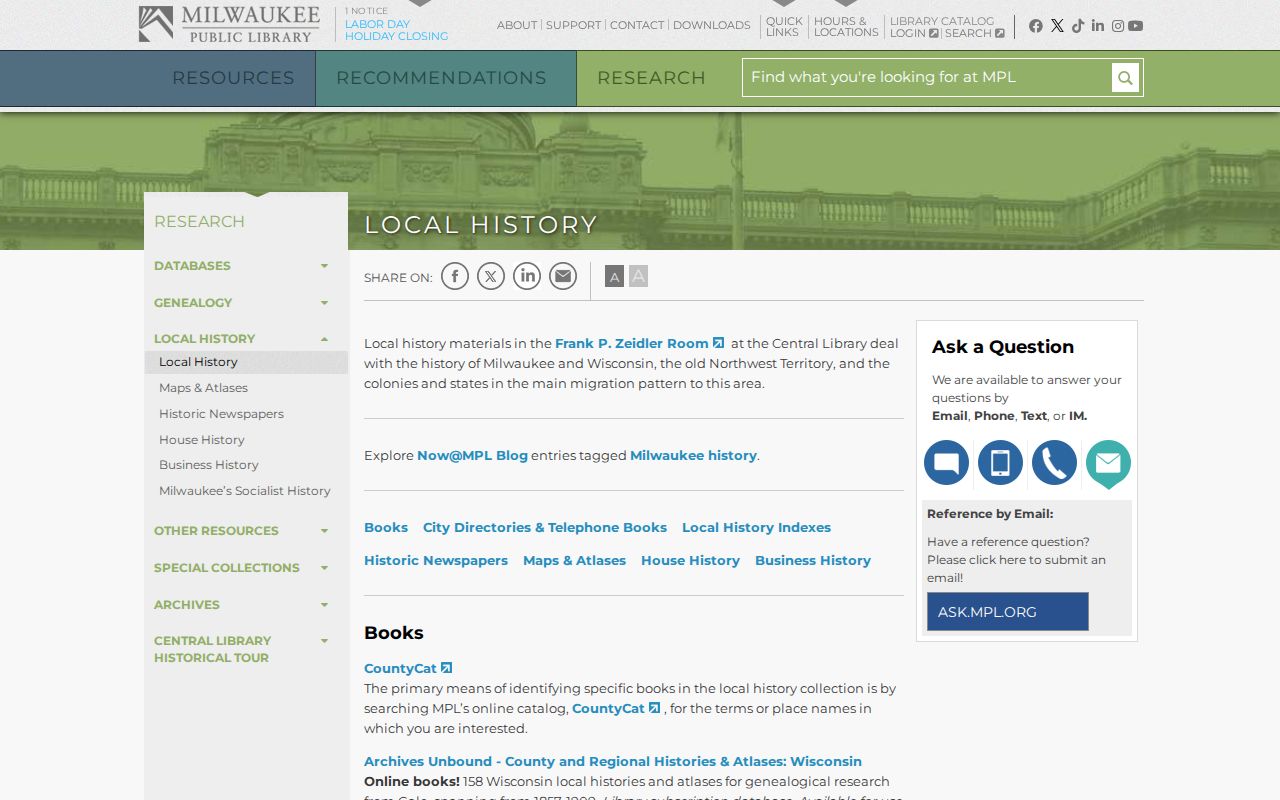
The Milwaukee Public Library local-history collection is the main access point for printed, filmed, and fiche directories. The Frank P. Zeidler Humanities Room also holds genealogy books, family histories, passenger lists, periodicals, census indexes, maps, newspapers, and local-history indexes. Reference staff can help locate a volume or explain which service desk holds its format.
The collection is practical for long searches because a name can be followed across yearly editions. Photograph or transcribe the title page, publication year, page number, and abbreviation key before recording an entry. A library catalog record proves that a volume exists, but it does not replace checking the live page and its symbols.
View the MPL local-history collection overview before choosing a directory format.
Milwaukee's 1921 Address Turn
Reverse directories begin in 1921. That change matters because earlier Milwaukee city directories require a name before an address can be found. From 1921 forward, the street guide can turn a historic house number into the listed occupant or business. It also shows nearby entries, which can help identify relatives, boarders, or a business associated with the same block.
A reverse listing is still only a dated publication. It should be paired with the name section and the book's abbreviation key. When a person disappears between editions, check the next and prior years before deciding what happened. A move, death, spelling variant, omission, or year without a published volume can all explain the gap.
- Criss-cross directory
- A volume or section ordered by street and house number.
- Householder index
- An address-based route to the named person or business printed for that year.
- Abbreviation key
- The volume-specific list that explains marks for residence, spouse, widow, boarder, owner, or other status.
Early Milwaukee Directory Publishers
The early CountyCat record identifies Murphy & Hogg with a Milwaukee city directory span of 1847-1884. Listed reference volumes include 1847/48, 1848/49, 1851/52, and 1856/57 through 1859/60. Later publishers vary, and the research did not establish a complete publisher-by-year list. Record the publisher from the title page rather than assuming it from the date.
The oldest years are available as microfiche as well as selected print volumes. That is useful when ink, binding, or a missing print book makes one format hard to use. It also prevents a catalog-wide year range from being mistaken for an unbroken annual run.
Convert Old Milwaukee Directory Addresses
Milwaukee changed almost all city address numbers in 1930, and many south-side street names changed. A city directory entry from before that change cannot safely be matched to a current parcel by number alone. The Historic Preservation Commission research page links the 1930 Address Change Directory and brings together permits, tax rolls, directories, deeds, census records, and Sanborn atlases.
Numbered streets are alphabetized by their spelled-out names in the converter. Cambridge Avenue changed more than once. The same PDF includes Wauwatosa street-name changes from 1931 on pages 208-213. This is one of Milwaukee's most important directory-search quirks, especially for parcels once associated with Wauwatosa or annexed municipalities.
Open the city property-research resources before translating an old address.

Read a Milwaukee City Directory Entry
Begin with the surname as printed. Note initials, a spouse or relative in parentheses, occupation, employer, residence, and any owner, boarder, roomer, widow, telephone, or business marks. The exact abbreviation key for that volume controls the meaning. Milwaukee's research file did not include a verified page image, so no one symbol should be treated as universal across all editions.
| Name | Indexed surname, given name or initials, sometimes a spouse or relative |
|---|---|
| Occupation | Trade and, in some entries, an employer or business |
| Residence | House number and street as used in that publication year |
| Status mark | Owner, boarder, roomer, or widow notation when that volume uses one |
| Later fields | Telephone mark, street-guide entry, or business-subject listing |
Copy what is present and what is absent. A residence address should not be confused with a business address. The street-guide entry can then confirm how that same address was indexed in the book.
Milwaukee History Society Directory Clues
The Milwaukee County Historical Society genealogy collections extend far beyond its directory run. Naturalization papers cover 1836 through May 25, 1941. The repository also holds civil court indexes and microfiche through 1974, marriage applications, jail registers, probate material, county records, family and business manuscripts, photographs, and more than 12,000 cubic feet of county-agency records.
The Harry Anderson Research Library is reference-only, so materials cannot be checked out. Contact the repository before traveling and ask about the exact volume or finding aid. Its address is 910 N. Dr. Martin Luther King Jr. Drive, Milwaukee, WI 53203-1591, and its listed phone is 414-273-8288.
Milwaukee Newspapers and Map Companions
Newspapers help explain a directory change. MPL's image runs include the Milwaukee Journal for 1884-1919 and 1921-1995, and the Milwaukee Sentinel for 1844-1865 and 1910-1995. Text-only Journal-Sentinel coverage begins in 1995. The Sentinel index for 1846-1890, WISDEX biographical index, Milwaukee History indexes, and Historic Milwaukee Echo index can lead to obituaries, marriage notices, business notices, and address changes.
Fire-insurance maps add the building. MPL lists atlases for 1876, 1888, 1894, and 1910. MCHS has incomplete later sets, while UWM offers selected 1894 and 1910 maps online. A map can show footprint, materials, additions, or former numbering, but it does not prove a household. The directory supplies the printed name, and census data adds household composition.
Note: Licensed newspaper databases may require a library card, while physical directories and archive collections may require an in-person visit.
Milwaukee Municipal Directory Research
The Municipal Research Library is the official depository for City of Milwaukee documents. It provides in-person, phone, and email reference service at 841 N. Broadway, Room B-2. The listed weekday hours are 8:00 a.m. to 4:45 p.m., and the phone is 414-286-2297.
Its digital archive contains selected material from city departments, Historic Preservation records, and City Records holdings. The City Records Center also supports public browsing of screened archival material, but E-Vault itself is restricted to the city network. Ask the Municipal Research Library for the public route when a catalog or web page points to a record that cannot be opened.
Trace Families in Milwaukee Directories
City directories fill the years between federal census releases. The 1950 census is the latest generally public federal census as of 2026 under the 72-year rule, and MCHS also lists Wisconsin's 1905 state census. Pairing directory years with those snapshots can distinguish a stable household from a brief listing.
- Find the first name-section entry and copy the exact spelling, year, page, address, and trade.
- Move one volume at a time, recording address changes and gaps rather than skipping straight to a later decade.
- From 1921 onward, check the address-order section for the occupant or business printed at the same location.
- Convert pre-1930 numbers, then compare the matching census, tax roll, or fire-insurance map.
- Use newspaper, obituary, naturalization, church, probate, or manuscript records to explain a disappearance or spelling change.
Milwaukee's German, Polish, Jewish, African American, Irish, and other community sources may preserve a surname under initials, a translated first name, or a different spelling. Search variants before concluding that two entries describe different people. Church files can help, but MCHS warns that no comprehensive church-file index exists, so search by denomination and congregation name.
| 1847 | Start of the documented Milwaukee directory run |
|---|---|
| 1921 | Address and reverse-directory searching begins |
| 1930 | Citywide address conversion changes most house numbers |
| 1990s-2002 | MCHS holdings become intermittent after 1990 |
A modern verification belongs in the Milwaukee resident lookup. Historical directory work should remain tied to the date and edition in which the name appeared.