
Finding Residents Across Milwaukee
Good Milwaukee research starts with a simple question: what can this record actually prove? An address can identify a parcel owner in the City Assessor roll. A name can lead to a recorded deed, a court case, an old directory entry. It can also surface a professional credential. Voters can check their own registration through MyVote. None of these is a complete household list. Owners sometimes live elsewhere. Renters rarely surface in land records, and some protected records are absent by design.
Treat the residents directory as a route through separate official systems. Write names exactly as each custodian displays them, initials and former surnames included. Record the tax key, case number, document number, date, and office too. Those identifiers make a second source far more useful than any broad name match.
- Search the City Assessor by owner or property address, then save the tax key and situs address.
- Use MyVote only to check your own registration with a name and date of birth.
- Match a current owner to the recorded transfer through the Register of Deeds.
- For an older address, consult Milwaukee Public Library directories and convert pre-1930 numbering first.
- When no portal has the needed record, contact its custodian at the counter, by mail, or with a focused public-records request.
Milwaukee Resident Records Desks
Three offices form the practical core of the Milwaukee residents directory. The Assessor maintains the current city parcel roll. The Register of Deeds holds recorded land instruments and issues local vital certificates. Election staff administer voter records. Wisconsin's statewide MyVote tool handles personal registration checks. Calling the right desk matters. The City Clerk does not keep every city record. Milwaukee names a department head or elected official as custodian for each office.
Milwaukee County Register of Deeds
901 N. 9th St., Room 103
Milwaukee, WI 53233
414-278-4021
City of Milwaukee Assessor
200 E. Wells St., Room 507
Milwaukee, WI 53202
414-286-3651
Milwaukee Election Commission
200 E. Wells St., Room 501
Milwaukee, WI 53202
414-286-3491
Assessor and city election desks list hours of Monday through Friday, 8:00 a.m. to 4:45 p.m. The Register of Deeds opens weekdays from 8:00 a.m. to 4:00 p.m. Holiday schedules vary, so verify before visiting.
Milwaukee Assessor Directory Fields
The free Assessor search links a current owner name to a parcel, but it does not identify every resident. Results display the owner as indexed, the situs address, tax key, property class, assessed land and improvement values, exemptions, and sale or assessment dates. A situs address is the parcel's physical location. It may differ from the owner's mailing address.
| Search field | Use | Format note |
|---|---|---|
| Owner name | Find parcels under a person or entity | Exact and partial behavior is not stated |
| Property address | Find the parcel at a city address | Validate the address through My Milwaukee Home |
| Tax key | Bridge the parcel to GIS and DNS | Numeric city parcel identifier |
| Result controls | Review a long result set | Print, next page, and last page |
The official Assessor result screen shows how the city lays out these fields.
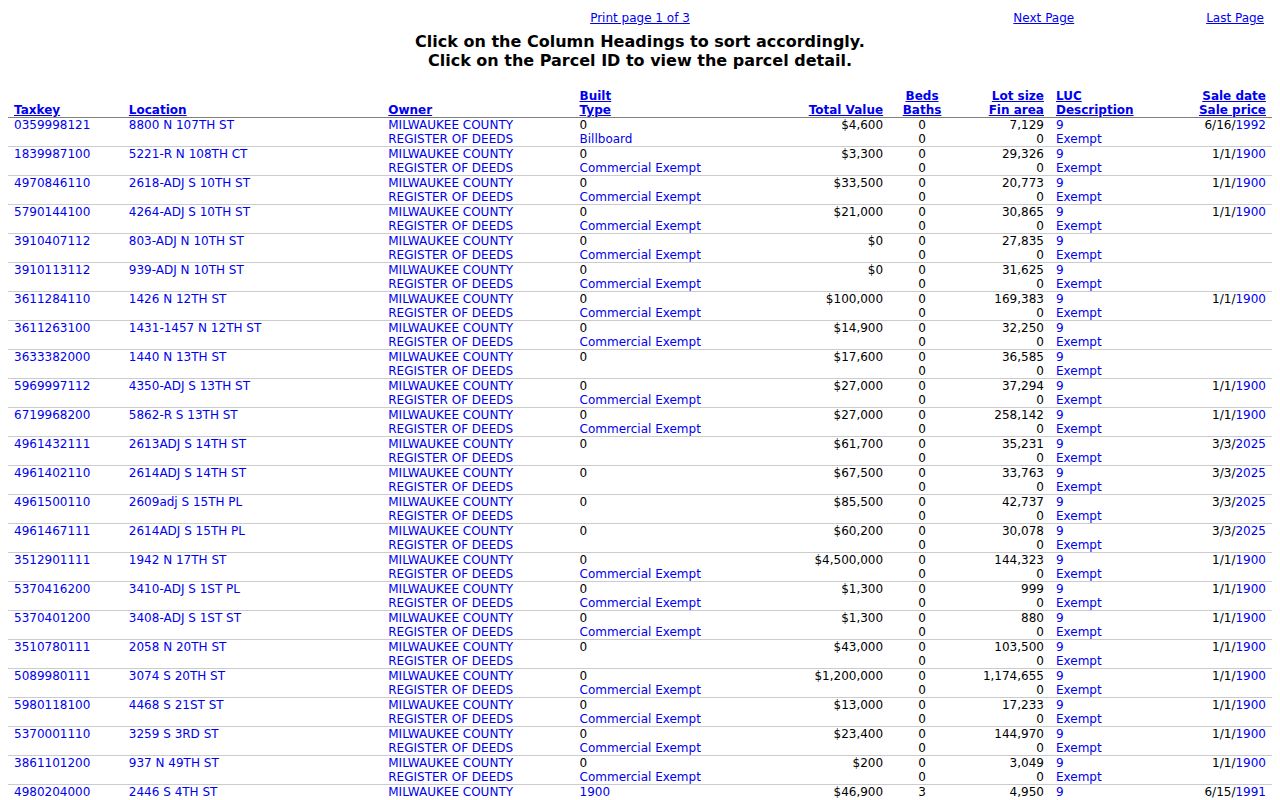
Treat the result grid as a parcel index, not a full resident roll. Carry the tax key into Map Milwaukee, DNS, or the deed system instead.
Current Milwaukee Resident Directories
Current Milwaukee records each list a different slice of the population. Scope and access rules matter more than the number of hits. The city property roll is free and direct. MyVote verifies only the searching voter's own record. Court portals disclose eligible case summaries. Land instruments are available online, at the county counter, or by mail, with fees for remote searches and copies.
| Official source | What it identifies | Custodian | Access route |
|---|---|---|---|
| Real Property Search | Recorded parcel owners | City Assessor | Free web search or office help |
| MyVote | The searching voter's registration | Wisconsin Elections Commission | Name and birth-date self-check |
| Real-estate index | Parties to deeds, mortgages, liens, and plats | County Register of Deeds | Tapestry, Laredo, counter, or mail |
| Court case systems | Parties in eligible public case summaries | State and Municipal Courts | Web summary, clerk terminal, or file request |
| License records | Named applicants and business affiliations | City Clerk or Wisconsin DSPS | Official online search and custodian request |
Commercial people-finder tools merge many kinds of data and may be stale, costly, or tied to the wrong person. Official rolls are narrower, but their fields carry a named custodian and a defined purpose. For one person's verification trail, use the Milwaukee resident lookup rather than accepting a single broad match.
Milwaukee Deed Directory Timeline
Milwaukee County's land archive covers roughly 300,000 parcels, with digitized real-estate instruments reaching back to 1835. That depth is a gift to researchers. The search method, however, changes with the record date, so modern name searching cannot simply be pushed through the whole collection.
- 1835 to March 31, 1948: digitized deeds require a document number or book and page.
- April 1, 1948 to present: deeds can be searched by grantor, grantee, tract, or document number.
- 1962 to present: all recording types support the broader digital search methods.
- 1920s to 1989: the city's Digital Reel grantor/grantee index by tax key can bridge part of the older trail.
A grantor transfers an interest; a grantee receives it. Tapestry costs $6.95 per search. Printed pages add $1.50 for the first and $1 for each added page. It cannot issue certified copies. County staff can make copies at the counter or by mail. Complex historical ownership work needs an appointment at least 24 hours ahead. Staff will guide the search but will not build the chain for a requester.
MyVote Is No Street Directory
MyVote asks for a first name, last name, and date of birth. A successful self-check can show current registration and election participation. It also shows absentee status and elected officials. It never reveals how anyone voted. Several matches can appear at once. The tool then asks the voter to pick “This is Me!” or reject the results.
The common myth is that MyVote can list everyone at a Milwaukee address. It cannot. The full statewide voter file requires a separate written request and fee under Wis. Stat. § 6.36. Public fields may include name, address, municipality, ward, districts, registration status, and election participation. Birth dates, driver-license numbers, Social Security numbers, confidential-elector addresses, and accommodation indicators stay restricted. A no-match does not prove anyone moved. Try name variants first, then ask election staff about the correct process.
Milwaukee Court Name Lookups
A name can land in two different Milwaukee courts. Wisconsin Circuit Court Access is better known as WCCA or CCAP. It posts eligible circuit-court case summaries online. Milwaukee Municipal Court is a separate system that handles city citations and ordinance matters. Pick the right court first. Then read the case type, the party role, the status, and the disposition with care. A matching name proves nothing by itself. An ordinance case is not a state criminal conviction.
A WCCA summary may list a case number, county, party name and role, filing date, case type, and status. It may also list the judge and event history. The full court file often holds more than the web summary shows. If the summary falls short, contact the Clerk of Circuit Court. A public-access terminal works too. Municipal Court accepts searches by case number, citation number, name, or business. Its website generally displays cases that remain unsatisfied. It also shows cases satisfied within the past five years. The municipal clerk also answers record correspondence by mail, fax, or email.
Milwaukee Vital Records Routes
Birth, death, marriage, and divorce certificates in Wisconsin are closed records under Wis. Stat. § 69.20. Eligibility is narrow. The registrant, immediate family, a legal representative, or a person with a direct and tangible interest can generally apply, bringing identification and the required fee. Certificates on file start in October 1907. Milwaukee County also issues its covered local records through the Register of Deeds, while older genealogy indexes are consulted under separate rules.
State copies arrive by mail or vendor. Mail requests go to Wisconsin Vital Records, and online or phone orders run through the state's approved vendor. Mail takes roughly ten business days to process. Online service is faster, at about five business days. The first certificate costs $20. Additional copies of the same record are $3 each. Milwaukee County takes in-person and mail applications with a $3 counter service fee, and its phone and online ordering adds vendor fees. Earlier divorce decrees come from the Clerk of Circuit Court rather than the one-page state divorce certificate.
Historical Milwaukee Resident Directories
Milwaukee's city directories run remarkably deep. The Milwaukee Public Library holds name volumes from 1847 to the present. Address-based listings run from 1921 forward. The Milwaukee County Historical Society reports a 1847 to 1990 run. Its reverse directories begin in 1921. A criss-cross volume sorts by street address. That arrangement places a listed householder at an address in a given publication year. The entry is not a legal finding of occupancy.
The Milwaukee Public Library local-history collection pairs directories with newspapers. It also offers address conversion tools, maps, and indexes.
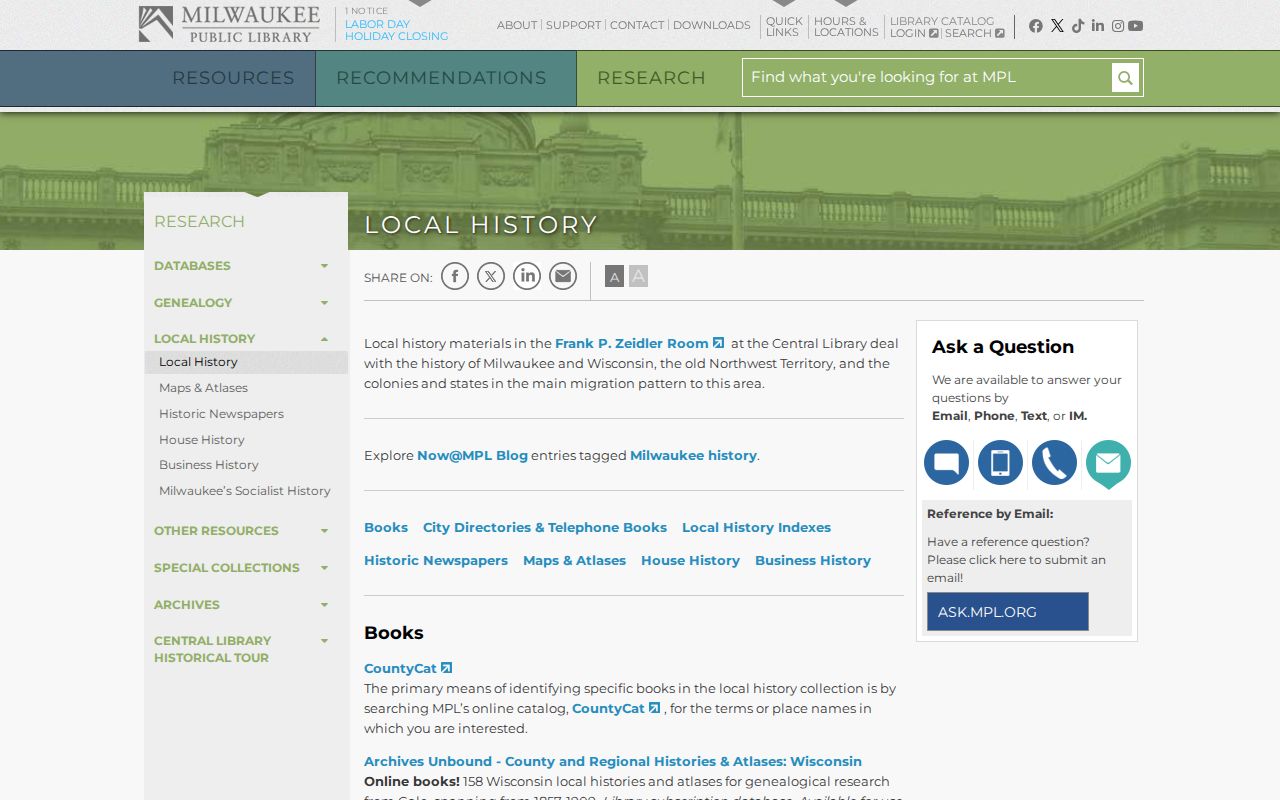
That library screen is only the doorway. Reference help waits in the Zeidler Humanities Room. The Municipal Research Center, the Historical Society, UWM libraries, and the Wisconsin Historical Society hold related archives beyond it.
Milwaukee's 1930 Directory Trap
Milwaukee pulled a cruel trick in 1930. Nearly every address number in the city changed, and some street names changed with them. Type a modern address into an older directory and you hit a false dead end. The Milwaukee Address Change Directory converts old and new numbers. It even covers Wauwatosa street-name changes from 1931. Numbered streets, oddly, are alphabetized by their spelled-out names.
Keep both address forms in your notes. Then check the converted number against the reverse directory, ward tax roll, permit, deed, census, or Sanborn fire-insurance map. Annexation creates one more snag. Records from the former Town of Lake, Town of Wauwatosa, North Milwaukee, Granville, or Bay View may sit under an earlier municipality, and a modern Milwaukee label cannot erase that history.
Milwaukee Directory Terms Decoded
A few record terms recur across Milwaukee searches. Knowing the limits of each term prevents a directory hit from being stretched too far.
- Roll
- An official list made for a defined purpose, such as assessment or voter administration.
- Index
- A finding aid that points to a document or case; it is not always the full record.
- Parcel
- A mapped unit of land identified by a tax key and legal description.
- Criss-cross directory
- A publication arranged by address, useful for finding a listed name on a street.
- Certified copy
- A custodian-issued copy formally attested as a copy of the official record.
Certain words follow you through any Milwaukee residents directory search. Terms like parcel, tax key, and grantor get used loosely, yet each points to a distinct kind of entry. Treat every Milwaukee city directory or property rolls result as a lead, not proof, until the underlying record backs it up.
When Milwaukee Portals Stop
Online search is only one access channel in Milwaukee County. Register of Deeds copies can be requested at the counter or by mail. Vital records use applications with identification and fees. Court clerks can provide eligible files and copies when the online summary is incomplete. The Development Center holds building-permit microfiche for city-limit structures built after 1888. Municipal Research Center staff offer in-person, phone, and email help with city documents, while library and archive staff guide older directory and map work.
For any city record that is not published, send a specific request to the department that keeps it under the Wisconsin Public Records Law, Wis. Stat. §§ 19.31-19.39. Wisconsin sets no universal number of response days. The authority must respond as soon as practicable and without delay. A strong request names the record, the date range, the address, the tax key, a case or document number, the preferred format, and whether certification is needed. Fees are limited to actual and necessary direct costs allowed by law.
Protected Milwaukee Resident Records
Not every gap in a residents directory is a mistake. Some are shields the law puts up on purpose. Safe at Home, Wisconsin's address confidentiality program under Wis. Stat. § 165.68, gives eligible participants a substitute address and forwards their mail. Confidential-elector rules can likewise keep a real home address out of voter records. Vital certificates, adoption files, and juvenile cases each carry their own access limits in Milwaukee County. Sealed files and expunged matters carry their own limits too.
Never try to defeat those safeguards by stitching sources together. Ask the records custodian what may be released. Stop when the law says a record is closed. Corrections go to the agency that created the data. Deleting a commercial listing never changes the official assessor, court, election, or vital record.
Milwaukee Family Search Paths
Family research in Milwaukee calls for the right source for the right relationship. Probate files can name a decedent, the personal representative, heirs, estate property, and addresses. A named heir is not always a current resident, though. Obituaries, church records, naturalization papers, yearbooks, and newspapers help separate people who share a surname. The Milwaukee County Historical Society holds naturalization papers from 1836 through May 25, 1941. It also keeps early court and county agency records.
Birth-family questions follow a regulated path. Wisconsin's Department of Children and Families runs an Adoption Records Search Program. It serves eligible applicants with Wisconsin-finalized adoptions. Most receive non-identifying information unless a statute permits names or contact details. The application fee is $40, and the stated process runs four to six weeks. That official program is safer and more accurate. It beats inferring a protected family link from scattered public records.
Milwaukee Records Need Two Matches
Treat a Milwaukee residents directory result as a verification chain. Before deciding two records describe the same person, compare at least two independent identifiers. A middle initial, a former surname, a tax key, a date range, a relative, or a court number can split a common-name hit apart. A business tie can do the same work. Milwaukee's German, Polish, Jewish, and African American history adds another wrinkle. An older resident may appear under initials, translated first names, Americanized forms, or alternate spellings.
Geography deserves equal care. Milwaukee city, Milwaukee County, postal ZIPs, planning neighborhoods, association areas, and wards simply do not share one boundary. Former townships follow their own lines too. A parcel map answers a land question. USPS answers a mailing question. An old city directory answers only what its publisher printed that year. When name, place, and time all line up, contact the official custodian. Ask for any copy a legal or estate matter will rely on.